
The steering wheel is the single most important tactile interface between a driver and their vehicle. Every microscopic vibration from the front tires, every shift in chassis weight, and every loss of traction is communicated directly through the rim of the wheel to the driver’s hands. For decades, automotive enthusiasts and professional racers have replaced bulky, uninspiring factory steering wheels with high-performance aftermarket alternatives to improve interior aesthetics, increase legroom, and drastically sharpen steering response.
Upgrading this critical component requires more than just picking a design you like. Installing an aftermarket steering wheel requires a foundational understanding of steering column mechanics, specific diameter geometry, and the crucial hardware known as a boss kit (or hub adapter) that bridges the gap between the car and the wheel. Whether you are building a grip-focused track weapon, a stylish drift chassis, or restoring a classic Japanese domestic market (JDM) legend, this comprehensive guide covers the history, the premium manufacturers, the selection process, and the technical fitment required to execute this modification perfectly.
The Engineering and History of the Aftermarket Wheel
The desire to swap steering wheels originated purely from motorsports. In the 1950s and 1960s, factory production cars featured massive steering wheels – often exceeding 400mm in diameter – to provide mechanical leverage before the invention of power steering. However, in enclosed cockpit racing, these massive wheels restricted driver movement, slowed down hand-over-hand steering transitions, and provided terrible feedback.
Racing engineers began crafting smaller, lighter steering wheels utilizing rigid aluminum or steel frames wrapped in high-grip materials like wood or rudimentary leather. By reducing the diameter, the steering ratio effectively felt quicker; a smaller movement of the hands resulted in a faster directional change of the front wheels.
Because every vehicle manufacturer utilizes a proprietary, heavily splined steering column shaft, it was impossible to create a universal steering wheel that bolted directly to every car. The aftermarket solved this by separating the system into two distinct parts: the steering wheel itself, which utilizes a universal 6-bolt mounting pattern, and the boss kit (hub adapter), a vehicle-specific sleeve that slides onto the factory steering column splines and provides the standardized 6-bolt mounting face for the wheel. This dual-component architecture remains the global standard today.
The Legends: Premier Steering Wheel Manufacturers
When browsing for interior parts, selecting a steering wheel from a reputable manufacturer is paramount for both safety and driving feel. A steering wheel is a critical safety device; cheap, counterfeit wheels are known to bend or snap entirely under heavy cornering loads. The following brands represent the pinnacle of automotive craftsmanship and JDM tuning culture.
Nardi and Personal
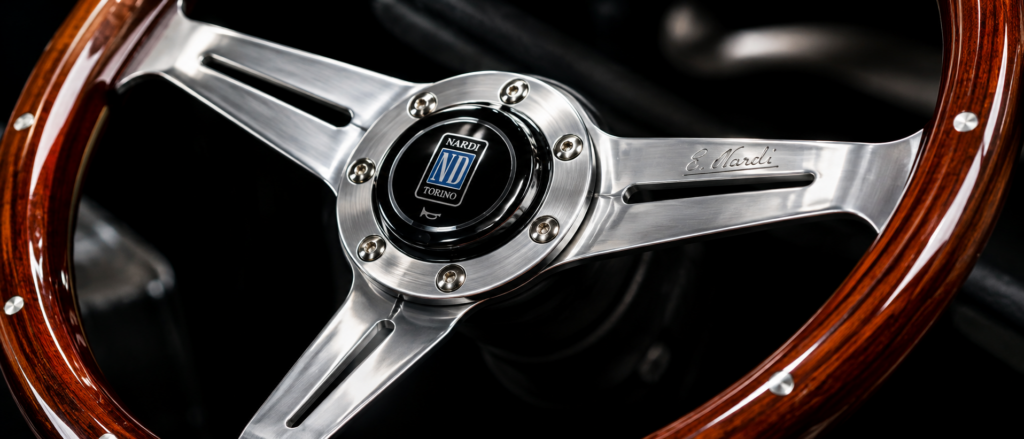
Founded in Italy by Enrico Nardi in 1932, Nardi is arguably the most prestigious steering wheel manufacturer in the world. Originally supplying steering wheels for Enzo Ferrari’s early race cars, Nardi is famous for its “Classico” line, featuring exquisite mahogany wood and polished spokes. In the JDM world, Nardi wheels are the golden standard for classic restorations, Mazda Miatas, and elegant street builds. Their sister brand, Personal, focuses more on aggressive, leather-wrapped motorsport designs favored by Formula 1 champions in the 1980s and 1990s. (Nardi utilizes a specific 6x74mm bolt pattern).
MOMO
Another Italian powerhouse, MOMO (Moretti Monza) was founded by race car driver Gianpiero Moretti in 1964. MOMO wheels are deeply ingrained in motorsport heritage. The MOMO Prototipo is a legendary design featuring circular cutouts in the spokes for weight reduction, making it a staple in vintage Porsche and early JDM Z-car builds. MOMO wheels utilize a 6x70mm bolt pattern, which has become the most widely adopted standard in the global aftermarket.
BBS
While globally recognized for their legendary multi-piece alloy wheels, BBS occasionally ventured into premium interior accessories in the 1980s and 1990s. Authentic BBS steering wheels (often manufactured in collaboration with Italvolanti) feature unique three-spoke and four-spoke designs with thick, heavily bolstered leather grips. Today, an authentic BBS steering wheel is a highly coveted, exceptionally rare collector’s item that commands top dollar on the secondary market.
Trust / GReddy
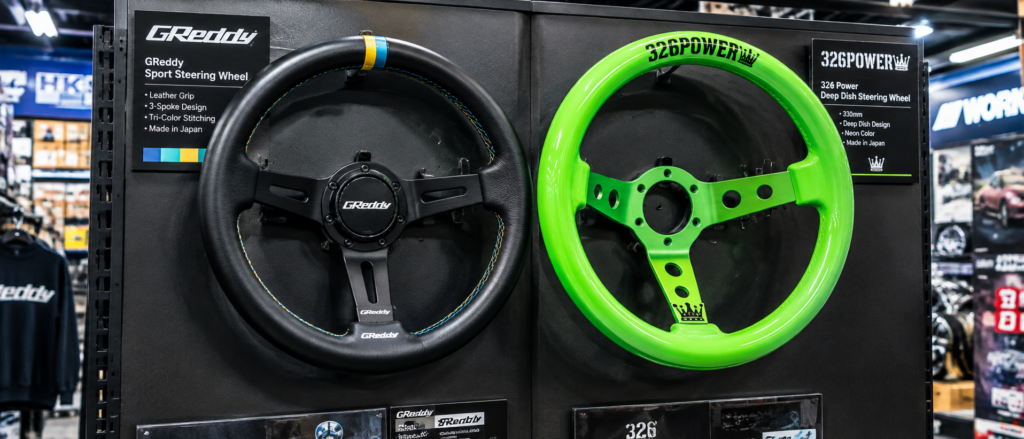
Transitioning into the pure Japanese tuning sphere, Trust (operating globally as GReddy) is famous for its performance parts and turbochargers. However, their interior accessories are legendary among 1990s JDM purists. GReddy steering wheels often feature the brand’s iconic tri-color stitching (blue, yellow, and teal) and aggressive, thick leather grips designed specifically for heavy track and highway use.
326 Power
Representing the modern, ultra-aggressive stance and drift culture, 326 Power was founded by legendary drifter Mitsuru Haruguchi. 326 Power steering wheels are not subtle. They are characterized by massive, deep-dish designs, vibrant neon colors, skull motifs, and extreme styling. For builders creating a slammed, widebody Nissan Silvia or Toyota 86 where visual impact is just as important as performance, 326 Power is the ultimate statement piece.
Vertex and Key!s Racing
T&E Vertex, founded by D1 Grand Prix champion Takahiro Ueno, produces some of the most sought-after drift steering wheels in Japan, often featuring elegant embroidery (like the Vertex “10-Star” model). Similarly, Key!s Racing, developed by racing legend Keiichi Tsuchiya, offers thick, D-shaped (flat-bottom) and round wheels optimized specifically for the rapid hand movements required in professional drifting.
How to Choose the Right Steering Wheel
Selecting the perfect steering wheel requires balancing aesthetic desires with strict ergonomic requirements. You must consider diameter, dish, and material to ensure the wheel complements your driving style.
1. Understanding Diameter
The diameter of the wheel drastically alters the steering feel and interior ergonomics of the vehicle.
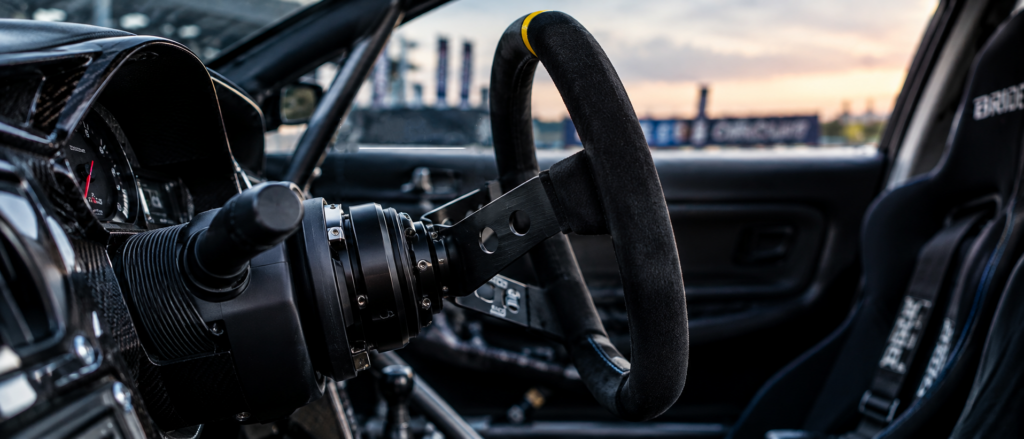
- 330mm (13 inches): Considered very small. A 330mm wheel provides a highly responsive, almost go-kart-like steering feel. It is excellent for drift cars where rapid counter-steering is necessary, and it provides massive leg clearance for tall drivers. However, it requires more physical effort to turn the wheels at low speeds and will often block the driver’s view of the factory gauge cluster.
- 350mm (13.8 inches): The industry standard. A 350mm wheel is the perfect middle ground, offering a sportier, slightly quicker feel than an OEM wheel without completely obscuring the speedometer or requiring excessive steering effort.
- 360mm+ (14.1+ inches): These larger sizes are typically reserved for classic cars (like the Nardi Classico) where a larger diameter is aesthetically appropriate and helps provide leverage for vehicles without power steering.
2. Choosing the Dish (Offset)
The “dish” refers to the depth of the steering wheel – the distance from the mounting hub to the actual grip rim.
- Flat (0mm – 30mm): A flat wheel keeps the rim at roughly the same distance from the driver as the factory steering wheel. This is ideal for retaining easy access to the turn signal and wiper stalks.
- Deep Dish (60mm – 90mm+): Deep dish wheels push the rim significantly closer to the driver’s chest. This is highly favored in motorsports and drifting because it allows the driver to maintain a bend in their elbows for maximum control while keeping their legs further away from the pedals. However, a deep dish wheel often means you will have to take your hand completely off the wheel to reach the turn signals.
3. Selecting the Material
- Suede and Alcantara: The ultimate choice for track cars. Suede provides unmatched grip, especially when the driver is wearing Nomex racing gloves. However, the oils and sweat from bare hands will rapidly degrade and flatten suede, making it a poor choice for daily driven street cars unless you commit to rigorous cleaning.
- Leather: The best all-around material. High-quality perforated or smooth leather is incredibly durable, comfortable for bare hands, and easy to clean. It is the standard for street cars and weekend cruisers.
- Wood: Exceptional for classic aesthetics and vintage builds. Wood wheels provide a rigid, direct feel, but they can become slippery if the driver’s hands are sweaty during aggressive driving.
Fitting Matters: Understanding the Boss Kit (Hub Adapter)
You have selected the perfect 350mm leather steering wheel. Now, you must attach it to the car. This is where the boss kit (hub adapter) comes in. The factory steering column is a bare metal shaft covered in vertical splines. A boss kit is a solid aluminum or steel cylinder featuring matching internal splines that slide perfectly over the steering column, secured by a single massive central nut. The front of the boss kit features threaded holes to accept the 6-bolt pattern of your new steering wheel.
Standard Hubs vs. Short Hubs
Boss kits come in different lengths. A standard boss kit is designed to mount a flat steering wheel at the correct factory distance from the driver.
However, if you are installing a deep-dish steering wheel, or if you plan to install a Quick Release mechanism (which adds another 2 to 3 inches of length), you must use a Short Hub. A short hub is a condensed boss kit that mounts flush against the steering column trim, compensating for the added length of the quick release or deep dish wheel so the steering wheel does not end up too close to the driver’s chest. Brands like Works Bell (Japan) and NRG are the industry leaders in manufacturing high-quality, vehicle-specific hubs.
The SRS Airbag Dilemma
Installing an aftermarket steering wheel in any modern vehicle (post-1990) requires removing the factory driver’s side airbag. When you unplug the factory airbag, the vehicle’s computer will instantly trigger a permanent SRS Airbag warning light on the dashboard.
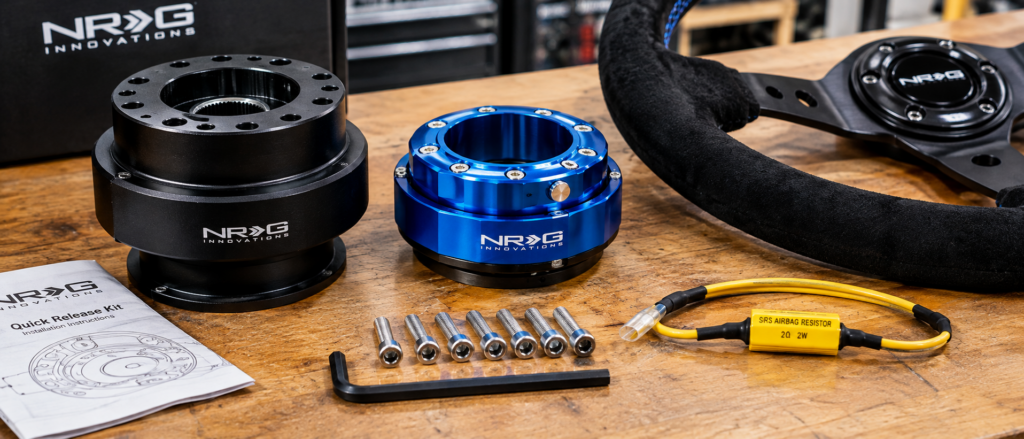
To solve this, premium boss kits (like those from Works Bell) include an SRS Airbag Defeat Resistor. This small electronic resistor plugs directly into the factory yellow airbag harness, tricking the car’s computer into thinking the airbag is still present, thereby keeping the warning light off and ensuring the passenger-side airbags continue to function properly.
Horn Wiring and Slip Rings
The boss kit also manages the horn wiring. Factory steering wheels use a complex clock-spring mechanism to keep wires connected while the wheel spins. When installing a boss kit, you often remove or bypass the clock spring. The boss kit will feature a metal contact ring (a slip ring) on the back that rubs against a fixed copper pin on the steering column, maintaining an electrical ground connection while the wheel turns. A single wire then runs from the front of the boss kit to the back of your aftermarket horn button.
The Quick Release Addition
While not strictly required, a quick-release mechanism is one of the most popular additions to an aftermarket steering wheel setup. A quick release is a two-piece mechanical locking device. One half bolts to the boss kit, and the other half bolts to the steering wheel. Using a ball-bearing locking collar, it allows the driver to instantly detach and remove the steering wheel from the vehicle.
Originally designed to allow race car drivers to climb out of roll-cage-equipped cockpits easily, quick releases serve two main purposes for street cars today. First, they provide a massive theft deterrent – a car is incredibly difficult to steal if it does not have a steering wheel. Second, they look phenomenal. The Works Bell Rapfix II is widely considered the pinnacle of quick-release technology, utilizing a patented ball-locking mechanism that guarantees zero steering play or slop, even after years of heavy use.
Safety and Installation Best Practices
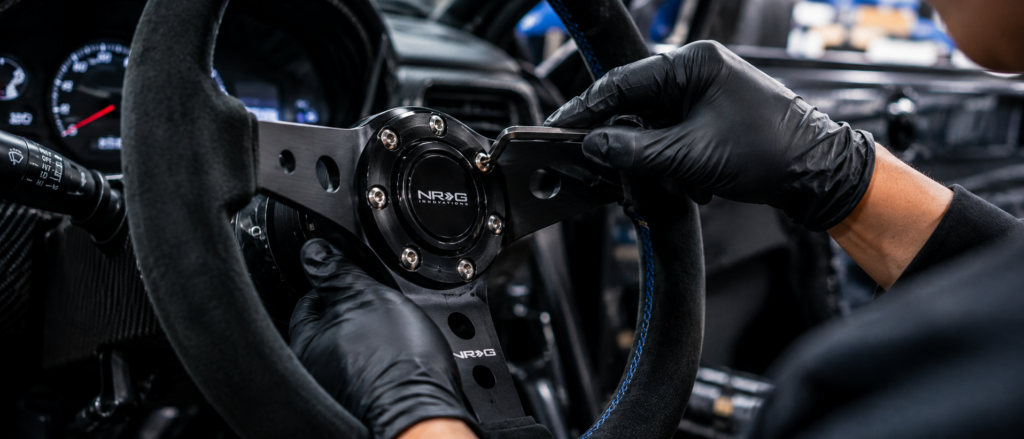
When installing a steering wheel and boss kit, precision is critical. The central steering column nut must be torqued precisely to the manufacturer’s factory specifications (usually around 25-35 ft-lbs). Failing to torque this nut correctly can result in the boss kit wobbling or vibrating loose over time.
Furthermore, you must ensure the front wheels are perfectly straight before removing the factory steering wheel. When sliding the new boss kit onto the splines, even being off by a single spline will result in a steering wheel that is permanently crooked when driving straight. Always test-fit the wheel, drive the car at low speeds in a safe area, and adjust the spline alignment if necessary before fully torquing the hardware.
Sourcing Your Driver’s Command Center
Replacing your steering wheel fundamentally changes how you interact with your vehicle. It elevates a standard commute into a tactile, engaging driving experience, and it provides the necessary control for high-limit track driving.
Because iconic wheels from Nardi, MOMO, and legendary JDM tuning houses like GReddy and 326 Power are highly sought after, finding authentic, high-quality pieces requires specialized sourcing. At UpGarage, we boast one of the largest global inventories of authentic, meticulously inspected used JDM parts. Whether you are hunting for a pristine, discontinued BBS wood-grain wheel, a track-ready Vertex suede wheel, or the vehicle-specific Works Bell boss kit required to mount them safely, our daily-updated inventory connects you directly to the finest automotive interior hardware in Japan. Upgrade your command center and feel the road exactly as it was meant to be felt.
The “Rare Part” market is moving faster than ever. Prices for iconic JDM brands are rising every year. By shopping used at Up Garage, you aren’t just saving money – you’re preserving a piece of automotive history and giving your car the authentic Japanese soul it deserves.
Ready to start your build? Visit https://ugarage.com/en/ and find your unicorn today!




Leave a Reply