
In 1999, the automotive landscape was shifting. The golden era of 1990s Japanese sports cars was slowly coming to a close as manufacturers began pivoting toward heavier, more electronic-laden touring cars. To celebrate its 50th anniversary, Honda decided to look backward to its roots while engineering a masterclass in modern mechanical purity. Drawing inspiration from its classic 1960s roadsters – the S500, S600, and S800 – Honda unleashed the S2000.
For the next decade, spanning the AP1 and AP2 generations, the S2000 redefined what a front-engine, rear-wheel-drive roadster could be. It was not a relaxed coastal cruiser; it was a high-strung, precision-engineered weapon that demanded the absolute most from its driver. Today, for purists and track-day enthusiasts seeking authentic Honda performance parts, the S2000 remains one of the most highly coveted platforms in Japanese Domestic Market (JDM) history. This comprehensive guide explores the engineering marvel of the F-Series engine, the critical differences between the AP1 and AP2 chassis, and how to properly tune this legendary roadster for the modern era.
The High X-Bone Frame: Engineering a Roofless Masterpiece
The fundamental challenge of designing any convertible sports car is structural rigidity. When you remove a vehicle’s roof, you remove a critical load-bearing structure, often resulting in “cowl shake” and a chassis that flexes under hard cornering. To ensure the S2000 could compete with fixed-roof sports cars on the race track, Honda engineers developed the “High X-Bone Frame.”
Instead of simply reinforcing the floorpan of an existing chassis, Honda designed an entirely bespoke platform. The High X-Bone Frame utilized a prominent central transmission tunnel that acted as a massive structural spine. This central tunnel connected to robust front and rear crossmembers, creating an “X” shape that distributed torsional loads evenly across the entire vehicle.
This innovative design allowed the S2000 to achieve a torsional rigidity exceeding that of many contemporary hardtop coupes. By placing the engine entirely behind the front axle line (creating a Front-Mid-Engine layout), Honda achieved a perfect 50:50 weight distribution. Coupled with a double-wishbone suspension setup at all four corners and a highly responsive Torsen limited-slip differential, the S2000’s chassis was engineered to deliver instantaneous feedback to the driver.
The Heartbeat: The F20C and the 9,000 RPM Redline
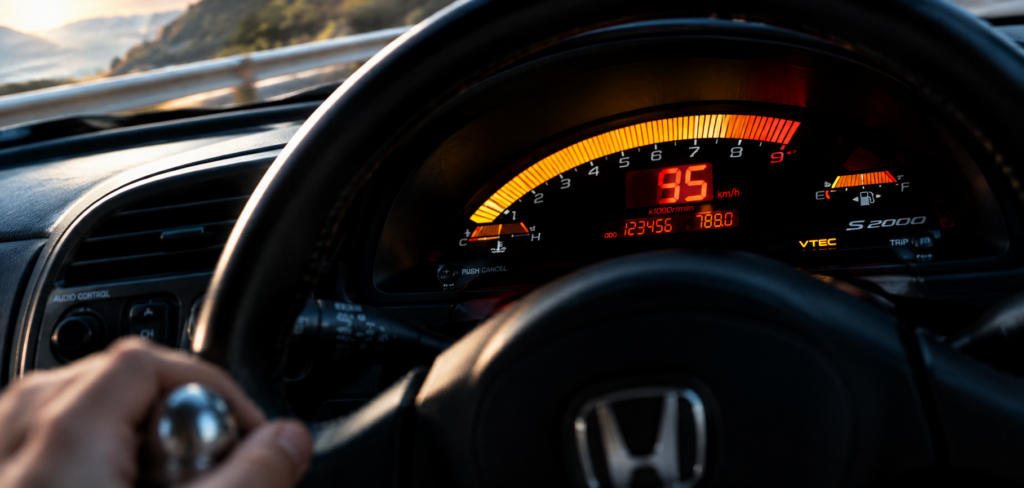
A brilliant chassis is nothing without a soul, and the soul of the AP1 S2000 is the F20C engine. This 2.0-liter, naturally aspirated inline-four is widely considered one of the greatest internal combustion engines ever manufactured.
Honda’s Formula 1 engineering pedigree was heavily applied to the F20C. To achieve an astronomical 9,000 RPM redline safely, the engine required incredibly lightweight and durable internals. Honda utilized forged aluminum pistons, lightweight connecting rods, and a ladder-frame main bearing stiffener to ensure the bottom end could withstand the massive inertial forces of high-RPM operation. The cylinder walls were treated with Fiber-Reinforced Metal (FRM) to reduce friction and improve heat dissipation.
The crowning achievement of the F20C was its VTEC (Variable Valve Timing and Lift Electronic Control) system. Below 6,000 RPM, the engine behaved like a standard, highly efficient Honda four-cylinder, ideal for commuting. However, once the tachometer crossed the 6,000 RPM threshold, the aggressive high-lift camshaft profile engaged. The induction noise transformed into a piercing mechanical scream, and the engine aggressively pulled all the way to its 9,000 RPM fuel cutoff.
Producing 240 horsepower from just 2.0 liters of displacement, the F20C achieved a specific output of 120 horsepower per liter. This set a world record for a naturally aspirated production car – a record it held for ten years until the debut of the Ferrari 458 Italia. Finding pristine, unmolested engine parts for the F20C remains a top priority for S2000 restorers today.
AP1 (1999–2003): The Unforgiving Scalpel
The first generation of the S2000, known as the AP1, is the rawest and most visceral iteration of the platform. Equipped exclusively with the 2.0-liter F20C engine and a remarkably crisp 6-speed manual transmission, the AP1 was engineered for experienced drivers.
However, the AP1 quickly earned a reputation for being aggressively unforgiving at the absolute limit of grip. The early double-wishbone rear suspension geometry was prone to dynamic toe changes under heavy cornering loads and abrupt throttle lift-off. If a driver panicked and lifted off the throttle mid-corner, the weight transfer would unload the rear tires, altering the toe geometry and resulting in sudden, snap oversteer.
For highly skilled drivers, this lively rear end allowed the car to be rotated easily on a tight race track. For inexperienced drivers, it resulted in many S2000s spinning off canyon roads. The AP1 was a true analog sports car that lacked electronic stability control, demanding respect, smooth inputs, and absolute concentration.
AP2 (2004–2009): Refining the Blade
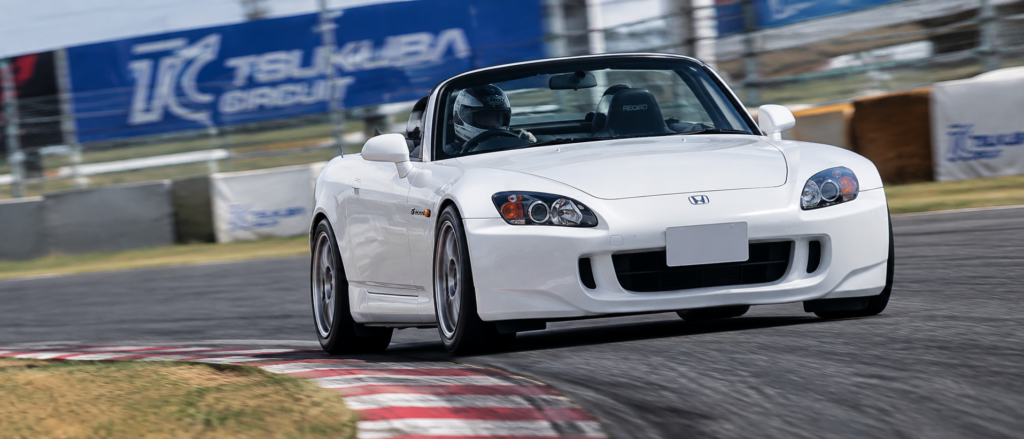
By 2004, Honda recognized the need to refine the S2000’s razor-sharp edges to make the car more accessible and predictable for a wider audience. The resulting AP2 generation brought significant mechanical and cosmetic changes that fundamentally altered the character of the car.
The F22C1 Engine (North American Market)
For the North American market, Honda replaced the 2.0L F20C with the 2.2-liter F22C1. By increasing the stroke of the engine, displacement was bumped up. This change lowered the famous redline from 9,000 RPM to 8,000 RPM, but it successfully addressed the biggest complaint from American consumers: a lack of daily-drivable low-end torque. The F22C1 produced the same 240 horsepower, but peak torque increased to 162 lb-ft, and it was available much lower in the rev range. (Note: The Japanese and European markets retained the 2.0L F20C until later in the production run).
Suspension and Chassis Revisions
To cure the AP1’s snap oversteer characteristics, Honda completely redesigned the rear suspension geometry for the AP2. They altered the rear toe settings, softened the rear sway bar, and stiffened the front springs. Additionally, they increased the wheel size from 16 inches to 17 inches, wrapping them in wider rear tires (245/40R17) to drastically improve mechanical grip.
Transmission and Cosmetic Updates
The AP2’s 6-speed manual transmission received carbon fiber synchronizers on all forward gears, resulting in an even smoother, more robust shifting experience. Visually, the AP2 was modernized with a revised front bumper, distinct triple-beam projector headlights, stunning LED taillights, and larger, oval exhaust tips. These exterior parts are highly sought after by AP1 owners looking to update the look of their older chassis.
The Ultimate Iterations: Club Racer (CR) and Type S
As the S2000 approached the end of its production cycle, Honda decided to send the legendary chassis out with highly focused, track-ready special editions.
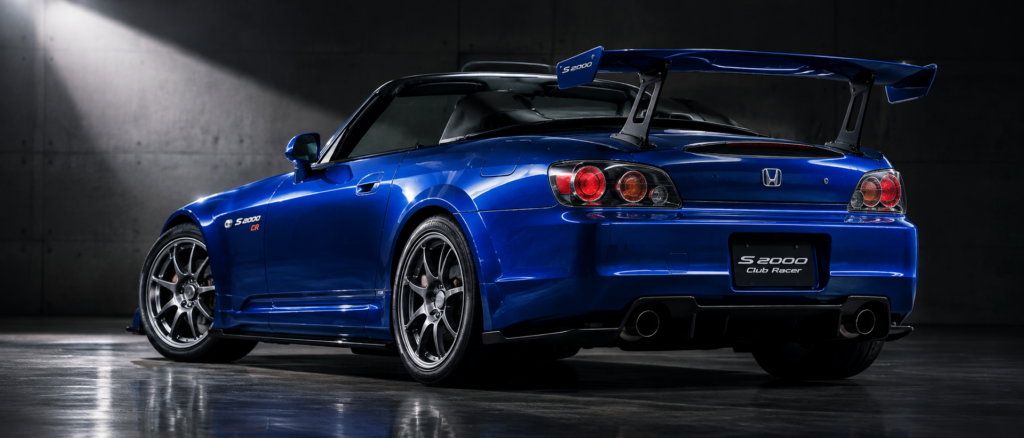
In North America, Honda introduced the S2000 CR (Club Racer) in 2008. Designed specifically to dominate weekend autocross and track events, the CR was stripped of its heavy folding soft top. In its place, Honda provided an aluminum tonneau cover and a removable, lightweight fiberglass hardtop.
The CR featured heavily revised, wind-tunnel-tested aerodynamics, including an aggressive front chin spoiler and a massive rear wing designed to reduce high-speed lift. The suspension was aggressively tuned with significantly stiffer springs and dampers, a quicker steering rack ratio, and wider rear tires (255/40R17). Internally, the air conditioning and radio were made optional to save further weight. Only 699 CR models were ever produced, making them incredibly valuable collector’s items today.
In Japan, Honda offered the Type S. While aesthetically similar to the American CR – sharing the same aggressive aerodynamic upgrades and suspension tuning – the Japanese Type S retained the standard folding soft top, making it a slightly more compromised but deeply enjoyable street car.
Tuning the S2000: Elevating Perfection
Because the S2000 left the factory as a highly optimized machine, modifying it requires a careful, strategic approach. Cheap parts will actively ruin the vehicle’s delicate balance. True enthusiasts turn to high-end, authentic JDM aftermarket components to unlock the platform’s ultimate potential.
Extracting Power: N/A vs. Forced Induction
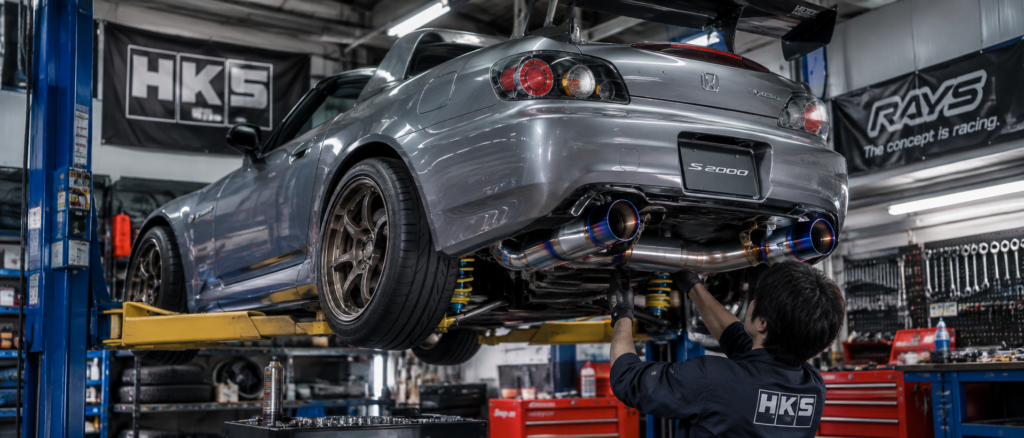
Tuning the naturally aspirated F-Series engine for significant power gains is notoriously difficult because Honda already extracted nearly every ounce of efficiency from the factory. Traditional bolt-ons like a high-flow intake, an aftermarket exhaust header, and a custom exhaust system will yield a beautiful exhaust note and perhaps 10 to 15 wheel horsepower when paired with a standalone ECU tune. For naturally aspirated purists, installing Individual Throttle Bodies (ITBs) offers unmatched throttle response and an intoxicating induction roar.
For owners seeking massive power, the F20C and F22C1 are incredibly robust and highly receptive to forced induction. High-quality supercharger kits (such as those from Kraftwerks or Comptech) are incredibly popular, providing a linear power curve that perfectly complements the S2000’s high-revving nature, easily pushing the car to 350-400 horsepower while maintaining stock engine internals.
Footwork and Aerodynamics
To match increased power, the suspension must be addressed. Installing high-end, fully adjustable coilovers from brands like Ohlins, KW, or Tein allows owners to corner-balance the vehicle and dial in precise damping for track use. Correcting the roll center geometry – especially on lowered AP1s – using aftermarket ball joints and tie rod ends is essential to maintaining proper handling characteristics.
In the global Time Attack scene, the S2000 is a dominant force, largely due to extensive aerodynamic modifications. Brands like Voltex, J’s Racing, and Spoon Sports have developed incredible, wind-tunnel-proven widebody kits, massive front splitters, and towering GT wings that generate massive downforce, transforming the S2000 from a nimble roadster into a high-speed aerodynamic weapon.
Sourcing Authentic Parts for Your S2000 Build
As the youngest Honda S2000 is now over 15 years old, keeping these mechanical masterpieces on the road and performing at their peak requires dedication. Pristine OEM components, such as original AP2 interior panels, glass-window soft tops, and uncracked dashboards, are becoming increasingly difficult to source directly from dealerships.
Whether you are performing a painstaking OEM restoration on an early AP1 or building a 500-horsepower, widebody AP2 for the race track, the secondary market is your most vital resource. To ensure your build matches the engineering pedigree of the chassis, you must rely on high-quality, authenticated components.
At UpGarage, we specialize in supplying enthusiasts worldwide with the finest used JDM parts. From authentic, discontinued Mugen hardtops and genuine J’s Racing titanium exhausts, to high-performance JDM wheels and tires engineered to fill out aggressive over-fenders, our inventory is constantly updated with rare finds directly from Japan.
The Honda S2000 is not just a car; it is an irreplaceable piece of automotive history that celebrates the pure, analog joy of driving. It rewards precision, demands respect, and delivers an adrenaline rush that modern turbocharged cars simply cannot replicate. Check our global store daily to find the precise aftermarket upgrades or rare OEM replacements you need to keep your 9,000 RPM legend screaming down the straightaways for years to come.




Leave a Reply